

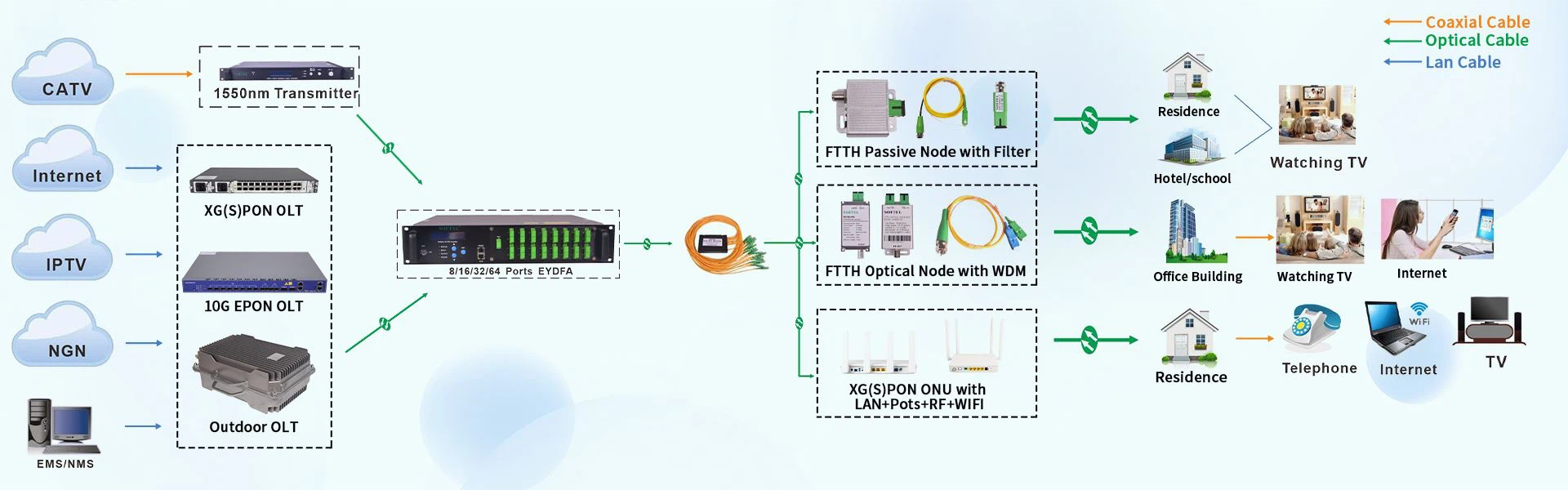
With the digital upgrades of smart campuses, intelligent manufacturing factories, schools, and large commercial complexes, traditional switch-and-copper-cable networks have shown multiple issues like short transmission distances, complicated wiring, strong electromagnetic interference, and scattered management of wireless APs. Hangzhou SOFTEL has developed a PON combined with an AC wireless controller and slim AP integrated transmission solution, using passive fiber as the wired transmission base across the entire area. With the AC managing all the wireless devices centrally, it supports office broadband, WiFi coverage, HD video surveillance, industrial IoT data, and voice intercom on a single network. At the same time, it ensures long-distance transmission, stable wireless coverage throughout, and lightweight maintenance, making it the go-to option for large-scale distributed digital networking.
3-layer PON AC Slim AP Integration Solution

The entire network setup is clearly layered, with all devices in the full chain being SOFTEL's self-developed communication products, adaptable for both commercial and industrial scenarios:
1.Core Data Center Layer: GPON/EPON OLT and AC Wireless Controller
The data center deploys PON OLT hosts, acting as the core of the all-optical network, outputting fiber signals downward to carry all wired services. It comes with a separate hardware AC controller or an OLT-integrated AC card to centrally manage all thin APs across the network. Core equipment in the data center can be divided into VLANs, logically isolating office WiFi, guest networks, industrial IoT, and surveillance data so that different services don't interfere with each other, ensuring the security of production data. Supports DC48V dual power redundancy, with automatic switchover during power outages to prevent network-wide downtime.
AC stands for Access Controller. It's the core management hub of the entire wireless network, specifically used to centrally manage all thin AP devices. It comes in two forms: standalone hardware AC and OLT-integrated AC cards.
Traditional fat APs without an AC need to be configured one by one, setting WiFi names, channels, passwords, and speed limits for each device. For buildings or campuses with dozens or even hundreds of APs, the workload is huge. An AC controller, on the other hand, allows all APs to go online with zero configuration, letting you edit all wireless parameters in the AC backend and then push them to all devices with one click.
AC combines gateway, authentication, and wireless management functions. Its core features include: intelligent wireless channel optimization, automatic AP transmit power adjustment, seamless roaming for terminals, dropping weak signal devices, multi-SSID business isolation, MAC black/white lists, WeChat/SMS guest authentication, multiple broadband line aggregation, and smart traffic allocation. It also supports remote cloud management, so maintenance staff can monitor each AP's online status, the number of connected terminals, and network traffic in real-time without going on-site, significantly cutting operational costs.
2. Passive Transport Layer: ODN Optical Distribution Network
Between the OLT and the front-end buildings or workshops, only passive optical splitters are deployed, with no active fault nodes and no need for power, greatly reducing the number of devices in the low-voltage room and cutting electricity costs. The fiber isn't affected by interference from factory motors, inverters, or substations, so there's no signal degradation or lag. Single-mode yellow fiber is suitable for long-distance factory areas, while short-distance indoor wiring can use orange multimode fiber, allowing flexible combinations based on needs.
PON, or Passive Optical Network, includes three core pieces of equipment: the OLT central office host, passive optical splitters, and ONU optical network units. It serves as the wired transmission foundation for the whole system. Unlike traditional active network switches, the ODN transmission link is completely passive, and the splitter doesn't need power. A single trunk fiber can split into dozens of terminals with a 1:16/1:32 split ratio. Fiber naturally resists electromagnetic interference and can transmit over long distances. A single-mode optical module can reach up to 120 km without a repeater, perfectly solving the problem of wiring across wide areas in factories or industrial parks, completely breaking the 100-meter limit of Ethernet cables.
3. Terminal Access Layer: ONT and Various Types of Slim APs
Deploy ONU at the end of the splitter, with two deployment modes:
Mode 1: Standalone PoE ONU. Converts fiber to RJ45 network port, which outputs PoE to power external ceiling, wall, or outdoor slim APs. A single cable carries both data and power, simplifying installation and wiring.
Mode 2: Integrated Optical WiFi ONU. Combines PON optical port and dual-band WiFi module in a compact unit. Can be directly wall-mounted in corridors or offices, reducing device stacking and saving rack space.
AP, or Wireless Access Point, is a terminal device that allows wireless devices like phones, tablets, AGV robots, and surveillance cameras to connect to a wired network. On the market, there are three types: Fat AP, Thin AP, and a Fat-Thin integrated AP. SOFTEL's full range of wireless products uses a fat-thin integrated design, allowing flexible deployment with switchable modes:
*Fat AP (Standalone AP): Comes with full routing and wireless management functions built-in and can operate independently without a controller. The downside is that multiple APs cannot be centrally managed, roaming can be laggy, and channel conflicts cannot be automatically optimized. It's only suitable for small shops or single-office setups with very few connection points.
*Thin AP (Fit AP): Doesn't have independent management capabilities, relying entirely on an AC controller for configuration and maintenance, only handling wireless signal transmission and reception. The advantage is seamless cooperation among multiple devices without interference, with millisecond-level seamless roaming when the terminal moves across APs. It's ideal for campuses, factories, and large-area multi-point coverage.
*Fat-Thin integrated AP: The standard form for SOFTEL's mainstream APs. For small projects, it can be used in fat mode independently, and when expanding the number of points later, it can switch to thin mode with one click to be managed by AC without replacing hardware, fitting the phased construction needs of projects.
AP products are categorized by usage scenarios into three types: Indoor 86-panel APs, indoor ceiling APs, and outdoor industrial APs / 5.8G wireless bridges. They cover dual bands, 2.4G and 5.8G. The 2.4G band has strong wall-penetration performance, perfect for large indoor user access; the 5.8G band has abundant channels, less interference from outside, and higher transmission speeds, often used for long-distance wireless monitoring in factories or outdoor point-to-point bridging. Power supply supports 48V PoE, transmitting data and power over a single cable, no need for separate power lines.
Core Advantages of the PON AC AP Integrated Solution
1. All-Optical Transmission Base, Suitable for Complex Industrial Environments
Traditional copper cables are easily affected by industrial electromagnetic interference, causing wireless disconnections and choppy surveillance video. PON fiber optic transmission has no electromagnetic radiation and completely isolates interference. Single-mode fiber can cover several kilometers of the factory area. The passive optical splitting architecture removes the need for aggregation switches on each floor's electrical room, reducing points of failure and lowering equipment procurement and ongoing maintenance costs. Industrial-grade PON and AP devices support a wide temperature range from -40℃ to 85℃, have IP40 dust protection, and can be directly deployed in outdoor factories, substations, and water stations.
2. Centralized AC Management, Seamless Wireless Experience Across the Entire Area
All thin APs are centrally managed by an AC, which includes smart channel analysis and power adjustment algorithms to automatically avoid channel conflicts with adjacent APs. When terminals move across workshops or buildings, seamless roaming is achieved within 20ms, ensuring network continuity for AGV robots, inspection tablets, and wireless cameras. It also supports multiple SSIDs for separate networks, logically isolating office LAN, guest WiFi, and workshop IoT devices. Paired with MAC authentication and WeChat guest authentication, it balances enterprise network security with guest internet access. In high-density scenarios, the AC automatically balances the load, relieving terminal access pressure, so conference rooms and cafeterias with thousands of concurrent users run smoothly.
3. Simplified Cabling, Significantly Reduced Overall Construction Costs
Traditional campus networking requires deployment of aggregation switches in each building, involving extensive cabling and high rack occupation. PON uses a point-to-multipoint topology, with a single trunk fiber able to cover all points in a building, reducing cabling materials by 70%. PoE ONUs can directly power APs, eliminating the need for separate power lines and outlets, cutting the overall construction time by half. For outdoor areas, fiber-optic composite cables can be used for combined power and transmission, making outdoor wiring more convenient. Future expansion only requires drawing fiber from the nearest splitter and adding ONU and AP, without modifying the main room backbone, making expansion hassle-free.
4. All-Service Integration, One Network Handles All Digital Needs
The complete PON AC AP network can simultaneously support office internet, high-definition wireless surveillance across the factory, workshop IoT sensors, voice intercom, and access control systems. OLT bandwidth can be easily upgraded to 10Gbps, meeting future 4K/8K video and high-bandwidth industrial data transmission needs. Network management functions support port speed limits, broadcast storm suppression, and link backup. Link failures automatically switch over, ensuring stable 24/7 operation.
Practical Application Scenarios
Scenario 1: Smart Manufacturing Factory / Industrial Park
With a large factory area and strong electromagnetic interference in workshops, the OLT is deployed in the machine room with an independent AC controller. The backbone fiber is laid to splitters in the weak current rooms of each workshop, and PoE ONUs are deployed in workshops with outdoor 5.8G industrial APs, covering production workshops, warehouses, office buildings, and park roads. The AC divides three types of wireless VLANs: office intranet, AGV IoT, and dedicated monitoring network. Fiber links prevent wireless drops caused by motor electromagnetic interference, and the AC remotely manages hundreds of APs without engineers needing to debug each workshop.

Scenario 2: University Campus / Chain Hotels / Commercial Complex
In densely built areas with high concurrent users, fiber reaches each hallway, with panel APs deployed and high-density ceiling APs in lobbies and meeting rooms. The AC uniformly sets up guest WeChat authentication, allowing customers to connect by scanning a code, providing seamless roaming across the building. Passive splitters eliminate the need for switches on each floor, greatly reducing maintenance workload, and phased hotel upgrades can use fat-thin integrated APs: initially operating in fat mode independently, and later connected to the AC for unified management after expansion.
Scenario 3: Substations, Water Conservancy, Mining Outdoor Industrial Networks
Outdoor points are scattered with large day-night temperature differences, so industrial-grade wide-temperature PON equipment is used with waterproof outdoor APs, and fiber enables long-distance transmission over tens of kilometers. The entire network supports ring self-healing, automatically switching to backup links if a fiber breaks. The AC remotely manages all outdoor APs from the cloud, reducing on-site inspection frequency.
Scenario 4: Small and Medium Enterprise Office Buildings
For small projects with fewer than 30 points, an OLT with integrated AC functionality is selected, avoiding the need to purchase separate controllers and reducing equipment investment. Panel APs are deployed in offices and ceiling APs in meeting rooms. PoE ONUs simplify wiring, meeting basic network needs for office work, visitors, and monitoring.

Key References for Project
1. PON Standard Selection: For small to medium bandwidth projects, choose EPON; for high-bandwidth scenarios like 4K surveillance and high-concurrency office use, choose GPON.
2. AC Controller Selection: If you have 32 APs or fewer, use OLT with an integrated AC card; if you have 50 APs or more, use a standalone hardware AC controller.
3. AP Equipment Selection: For indoor offices and hotels, use dual-band panel/ceiling APs; for long-distance coverage in factories or outdoor surveillance backhaul, use 5.8G industrial wireless bridges.
4. Power Supply Plan: For indoor scenarios, prioritize ONU with PoE output; for industrial outdoor scenarios, choose DC48V dual-power redundant ONU to ensure stable power supply.
5. Environment Adaptation: For harsh environments like factories, open fields, and substations, uniformly use industrial-grade PON and AP equipment with wide temperature range, high dust protection, and strong electromagnetic interference resistance. ...
Conclusion
Amid the wave of industrial digitalization and smart park development, PON passive optical networks provide a long-distance, highly stable, and interference-resistant wired transmission foundation. When paired with AC controllers and slim APs, they build a unified, smoothly roaming, full-area wireless coverage system. The deep integration of the two completely addresses the key pain points of traditional copper cabling networks, like complicated wiring, limited transmission, and hard-to-manage, scattered wireless connections.
Hangzhou Softel Optic has a fully self-developed product line, covering OLTs, optical splitters, ONUs, AC wireless controllers, full-series integrated fat and slim APs, and industrial wireless bridges, meeting diverse needs across commercial, industrial, and dedicated network scenarios. With a super simple networking architecture, lower overall construction costs, and 24/7 stable and reliable network capabilities, it provides factories, parks, campuses, and government/enterprise units with a one-stop, full-optical wireless integrated solution for PON AC APs.
Hangzhou Softel Optic Co., Ltd
708-709 Haiwei Building, Binjiang District, Hangzhou, Zhejiang Province, China
Email: info@softel-optic.com
Whatsapp: +86 13588723749
Facebook: Softel Optic Co., Ltd


