



Coaxial Cables
Coaxial cables are a cable structure composed of inner conductors, insulation layers, outer conductors (shielding) and outer jackets arranged in turn coaxial arrangement, which can effectively reduce electromagnetic interference (EMI) and radio frequency interference (RFI) through the shielding of the inner and outer conductors sharing the same axis and the outer conductors, while reducing the loss during signal transmission. This cable is widely used in TV signal transmission, cable TV networks, communication systems, monitoring equipment connections, and RF signal transmission, and is one of the common transmission media in traditional cable communication.


advantages
Durable Structure
The outer sheath protects the internal structure, has a certain degree of physical toughness and environmental adaptability, and is suitable for a variety of installation environments.
Low signal loss
The loss in medium and high frequency signal transmission is small, making it suitable for long-distance transmission.
Strong anti-interference ability
The outer conductor (shielding layer) can effectively block electromagnetic interference (EMI) and radio frequency interference (RFI).
competitive price
Low manufacturing and deployment costs, excellent performance ratio
types of coaxial cables
By impedance
· 50Ω coaxial cable: Mostly used in RF communication, radar, wireless network, base station connection and other scenarios (such as LMR series, RG-8, RG-58).
· 75Ω Coaxial Cable: Suitable for TV signals, cable television (CATV), video surveillance, etc. (such as RG-6, RG-59).
· Other special impedances: such as 93Ω (such as RG-62A/U for specific data transmission).
By structure & performance
· RG series Cable: traditional general-purpose types, such as RG-6 (low loss, commonly used cable TV), RG-11 (thicker, long-distance transmission), RG-59 (thinner, short-range video).
· LMR series Cable: high-performance and low-loss types, such as LMR-400 (medium and long-range RF communication), LMR-600 (long-range high-power applications).
· Armored cable: The outer layer is armored with metal, resistant to mechanical damage, suitable for harsh environments such as outdoors and underground.
By Application
· Communication cables: for base stations, point-to-point RF links (e.g., LMR-400, RG-8).
· Broadcast cables: cable, satellite transmissions (e.g., RG-6, RG-11).
· Industrial/Test Cables: High and low temperature resistance, low intermodulation for aerospace, medical equipment (e.g., RG401, Lab-Flex® S series).
FAQ
Q: What are the specific applications of coaxial cables in communication networks?
A:
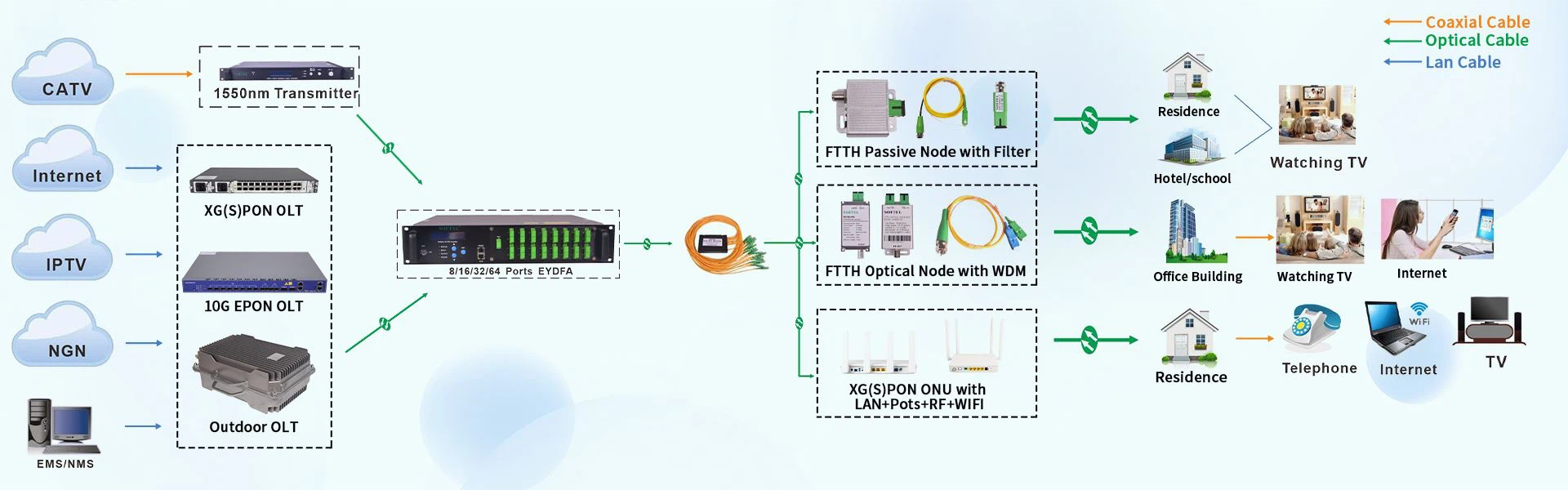
1. Cable Television (CATV): Traditional coaxial cable networks remain the mainstay of cable signal transmission for home and commercial cable, supporting high-definition, 4K/8K video.
2. Broadband Access (DOCSIS Technology): Provides last-mile broadband access for homes and businesses through hybrid fiber coaxial networks (HFC).
3. 5G Base Station RF Connection: Used for signal transmission between base station antennas and radio frequency units (RRUs), especially in the Sub-6GHz frequency band.
Q: What is the difference between fiber optic cable and coaxial cable?
A:
1. Optical cable fibers use light pulses to transmit data (light signals) with total reflection in glass/plastic fibers.
Coaxial cables transmit electrical signals through the electromagnetic field of the central conductor and outer shield.
2. The fiber optic cable bandwidth is ultra-high, up to Tbps level, and the transmission distance can reach 100 kilometers without relay.
Coaxial cable bandwidths typically < 10 Gbps and transmission distances are moderate, typically < 500 meters.
3. Optical cable is mainly used in backbone networks (such as 5G base station interconnection), data centers, long-distance communication (submarine optical cables), and high-definition live video.
Coaxial cables are mainly used in home broadband (DOCSIS technology), cable television (CATV), security monitoring, and short-range radio frequency transmission (such as satellite signals).
4. The initial deployment cost of optical fiber cable is high, requiring photoelectric conversion equipment, but the long-term maintenance cost is low.
Coaxial cables are simple and inexpensive to install, but require regular maintenance of the shield and connectors to prevent oxidation.
Q: What factors affect the price of coaxial cable?
A:
1. The main raw materials of coaxial cables include metal conductors such as copper and aluminum, as well as insulating materials such as plastic. Fluctuations in copper and aluminum prices will directly affect the cost of cables, usually copper conductors are more expensive than aluminum conductors, and oxygen-free copper is more expensive than ordinary copper. The variety of insulation and sheathing materials also affects the price, such as cross-linked polyethylene (XLPE), which is more expensive than regular PVC.
2. The larger the conductor cross-sectional area of the cable and the higher the rated voltage, the higher the price. The price of coaxial cables with different impedances varies, such as 50Ω commonly used for RF communication and 75Ω for TV signal transmission may be different. In addition, coaxial cables for special purposes, such as coaxial cables used in superconducting quantum computing, are much more expensive than ordinary coaxial cables because they need to meet special requirements such as low-temperature compatibility and high-frequency stability.
3. High-end or special types of coaxial cables, such as semi-rigid coaxial cables, armored cables, etc., require more advanced production equipment, higher process levels and stricter quality control, high production costs, and correspondingly higher prices.