

What is OLT?
Optical line terminals, or OLTs for short, are devices that link optical fibers and transfer signals. In PON (passive optical network), it has a major impact.
What are the functions of OLT?
1. To begin with, OLT converts into optical signals by connecting via cable to the coverage level switch. Additionally, it has an optical fiber connection to the optical splitter on the consumer terminals.
2. Measure, control, and oversee the distance to ONU and other client terminal devices.
3. One of the gadgets on the access network's service nodes is OLT. By connecting via SNI port to the appropriate service node devices, it completes the service access.
What are the components of OLT?
Typically, OLT is composed of: 1. Control board. On an OLT, there are typically two boards: the main board and the backup board.
2. A board for a DC power supply
3. Fan unit. Its primary functions are environmental monitoring and heat dissipation.
4. The service framework
5. Additional uplink forums
What are the types of OLT?
GPON and EPON OLT are included in OLT. Both 4 port and 8/16 port GPON OLTs are available. 4/8/16 ports are another division of EPON OLT. These are little designs that have a wide range of applications. It guarantees a secure network with carrier-class security protection and support for both SPF and RIP dynamic routing protocols. It offers numerous service management features, including CATV, VoIP, WiFi configuration, Internet access, and security control.
What are the applications of OLT?
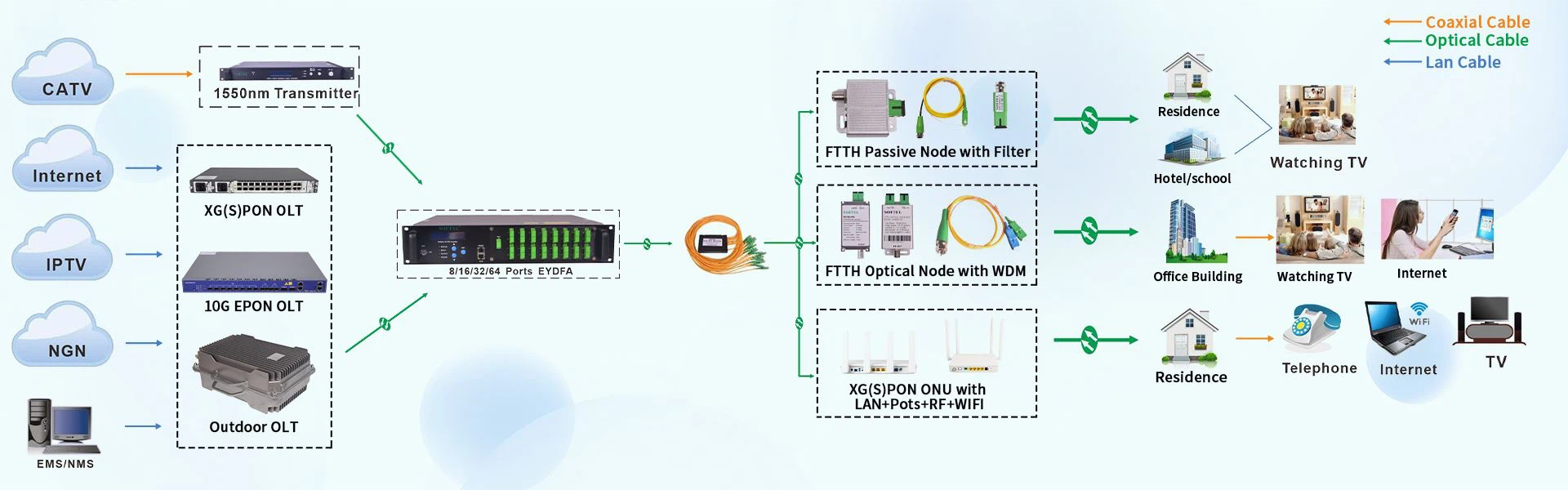
To achieve all sorts of access networks, including FTTC, FTTH, FTTO, FTTM, etc., the OLT device coordinates with various ONU types. There are several deployment tactics based on the services offered, the demands of the clients, and the geographical location.
This is a FTTH (Fiber to the Home) application using the V-SOL EPON OLT device V1600D4-DP, as seen in the image below. The ONU and management switch are connected to the OLT. A splitter separates ONU from OLT. Many households can benefit from a variety of services offered by the entire PON, including IPTV, VoIP, IP cameras, etc.


