

Differences between XGPON and GPON in fiber optic networks
GPON
In the past few years, PON standards have undergone changes. First, in the late 1990s, the International Telecommunication Union proposed APON for packet communication using Asynchronous Transfer Mode (ATM).
Later, when ATM was no longer used, they proposed the concept of Broadband Passive Optical Network (BPON).
Today, although BPON is still useful in a few systems, most optical networks have begun to use Gigabit PON (GPON), and the corresponding transmission protocol is G.984, which can achieve 2.488Gbits/s download rate and 1.244Gbits/s upload rate.

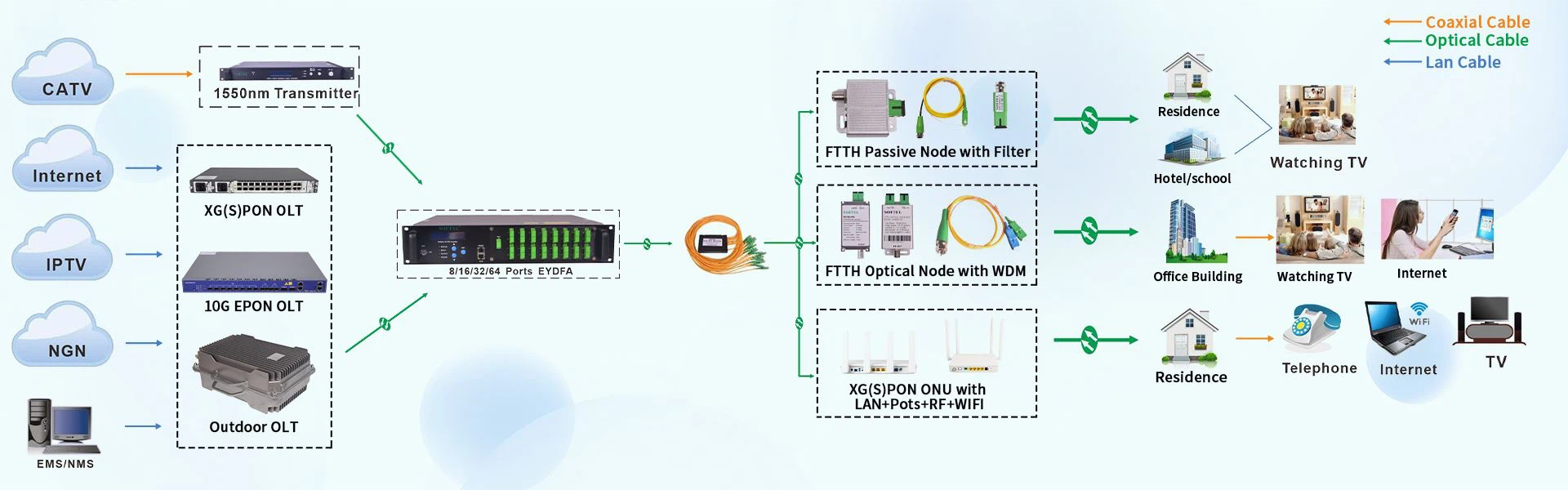
GPON uses Wavelength Division Multiplexing (WDM) technology to enable uploading and downloading at the same time. Usually, 1490nm optical carrier is used for downloading, and 1310nm optical carrier is selected for uploading at the same time. If TV signals need to be transmitted, it will also be A 1550nm optical carrier is used.
Although each ONU can obtain a download speed of 2.488Gbits/s, GPON also uses Time Division Multiple Access (TDMA) to allocate a certain time slot in the periodic signal for each user. Therefore, the download rate reflected to each user terminal is only a part of the total rate, such as 100Mbits/s, depending on how the optical communication operator allocates it.
With the increasing demand for video and OTT TV services, it is more and more necessary to increase the line rate to process the massive data of high-definition video, so the latest generation of GPON came into being, called XGPON or 10G-PON, corresponding to The ITU protocol is G.987.
The maximum download rate of XGPON is as high as 10Gbits/s, and the upload rate is also 2.5Gbits/s. It also adopts WDM technology, and the wavelengths of the uplink and download optical carriers are 1270nm and 1577nm respectively.
Due to the increased transmission rate, according to the same data format, it can be branched to more ONUs, and the maximum coverage distance can reach 20km. Although XGPON has not been widely adopted, it provides a good upgrade path for optical communication operators.


