

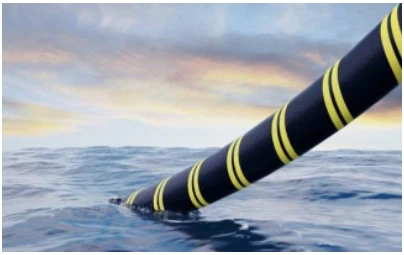
Submarine cables are cables that are wrapped with insulating materials and laid on the seabed for telecommunication or power transmission. Generally, it can be divided into submarine communication cables and submarine power cables.

Submarine Communication Cable
Mainly used for long-distance communication network. It is usually used in more important occasions such as remote islands and cross-sea military facilities. Modern submarine communication cables use optical fibers as the material to transmit telephone and Internet signals.
Submarine Power Cable
The laying distance is much shorter than that of communication cables, and is mainly used in scenarios such as between land islands, crossing rivers or harbors, connecting drilling platforms from land or interconnecting between drilling platforms.
Submarine cable laying mainly includes three stages: cable routing survey and cleaning (before), submarine cable laying (middle) and buried protection (after).
Before submarine cable laying - cable routing survey
Including: cleaning the water depth, topography, shallow stratum profile measurement, sediment surface sampling, column sampling and static penetration survey of the offshore routing area, as well as traffic and construction conditions and obstacles that reflect the status of marine development activities.
Recently, the use of advanced GPS post-processing positioning and (CPT) static penetration technology has greatly improved the survey speed and effect.
Submarine cable laying - recognized complex and difficult large-scale projects
When laying submarine cables, it is necessary to control the water entry angle and laying tension of the cables by controlling the sailing speed of the laying ship and the cable release speed, so as to avoid damage to the cables due to too small bending radius or excessive tension.
In the shallow sea, such as the sea area where the water depth is less than 200 meters, the cables are buried. In the deep sea, laying is adopted, the cable is released by the cable laying ship, and the underwater monitor and underwater remote control vehicle are used to continuously monitor and adjust, and control the forward speed and direction of the laying ship and the speed of laying the cable to bypass the unevenness. Uneven places and rocks avoid damaging the cable.
After the submarine cable is laid - burial protection
In the final stage of construction, the main purpose is to protect the submarine cables by deep burial to reduce the impact of the complex marine environment on the submarine cables and ensure safe operation.
In the sandy and silt areas, use high-pressure flushing water to create a trench about 2 meters deep, bury the cable in it, and cover it with sand next to it; in the coral reef and clay areas, use a cutting machine to cut a 0.6-1 .2m deep trench, bury the cable in the trench and backfill naturally to form protection; in hard rock area, cover the cable with hard objects such as cement cover for protection.
The submarine cable project is recognized as a complex and difficult large-scale project by countries all over the world. Sophisticated techniques are used in everything from environmental detection, marine physical surveys, to the design, manufacture and installation of cables.

According to incomplete statistics, the number of submarine cables under construction and operation in the world has exceeded 400, with a total length of more than 1.3 million kilometers. Among them, 99% of the transoceanic Internet data transmission is carried out through submarine cables.


