

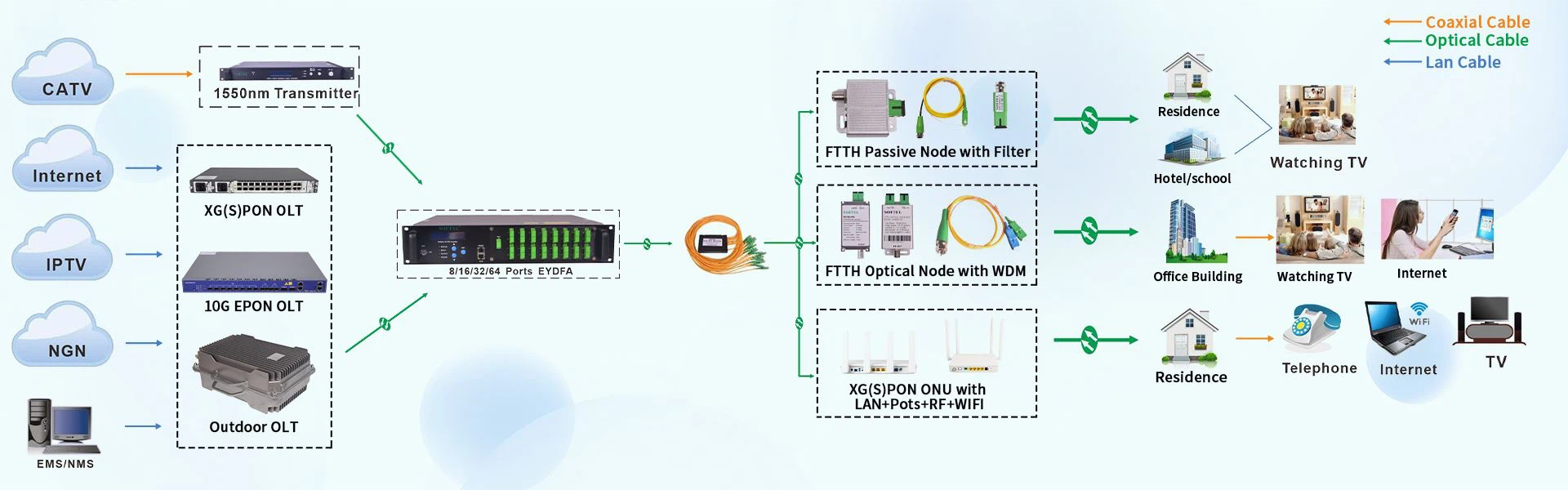
Optical fiber access means that end users are connected to central office equipment through optical fibers. According to the degree of fiber penetration into users, fiber access can be divided into FTTB (Fiber To The Building, fiber to the building), FTTP/FTTH (extend the fiber optic cable to the home or business), FTTO (fiber to the office), FTTC ( fiber to the curb), etc., they are collectively referred to as FTTx.
There are two main ways to connect ONUs with optical fibers. One is the point-to-point topology P2P (Point to Point), which uses an optical fiber from the central office to each user; the other is the point-to-multipoint topology P2MP (Point to Point). Multi-Point) passive optical network PON (Passive Optical Network).
P2P peer-to-peer FTTx solution

Ethernet (Ethernet) + Media Converter MC (Media? Converter) is a transitional point-to-point FTTx scheme, which uses MC to convert electrical signals into optical signals for long-distance transmission. The point-to-point method has the advantages of guaranteed bandwidth speed, the high utilization rate of equipment ports, better security of user information, a long transmission distance, and a large service area. However, a large number of optical fibers and optical transceivers need to be laid at the same time, and the equipment cost is high.
P2MP point-to-multipoint topology FTTx solution

Passive Optical Network PON (Passive Optical Network) technology is a point-to-multipoint optical fiber access technology. It consists of OLT in the central office, ONU at the user end, and ODN. The OLT is placed in the central computer room, and the ONT/ONU is placed at the user end. . ODN is all composed of passive components such as an optical splitter (Splitter), without any active electronic components and an electronic power supply, that is, PON network. Its architecture is mainly from the optical fiber line terminal equipment (OLT) downlink through a fiber through a passive device - optical splitter, the optical signal split broadcast to each optical user terminal equipment (ONT). The passive technology at this stage is composed of a combination of various technologies, including APON and GPON, and EPON is also one of the important technologies. The currently widely used PON technology includes two mainstream technologies in the existing network: EPON and GPON.


