

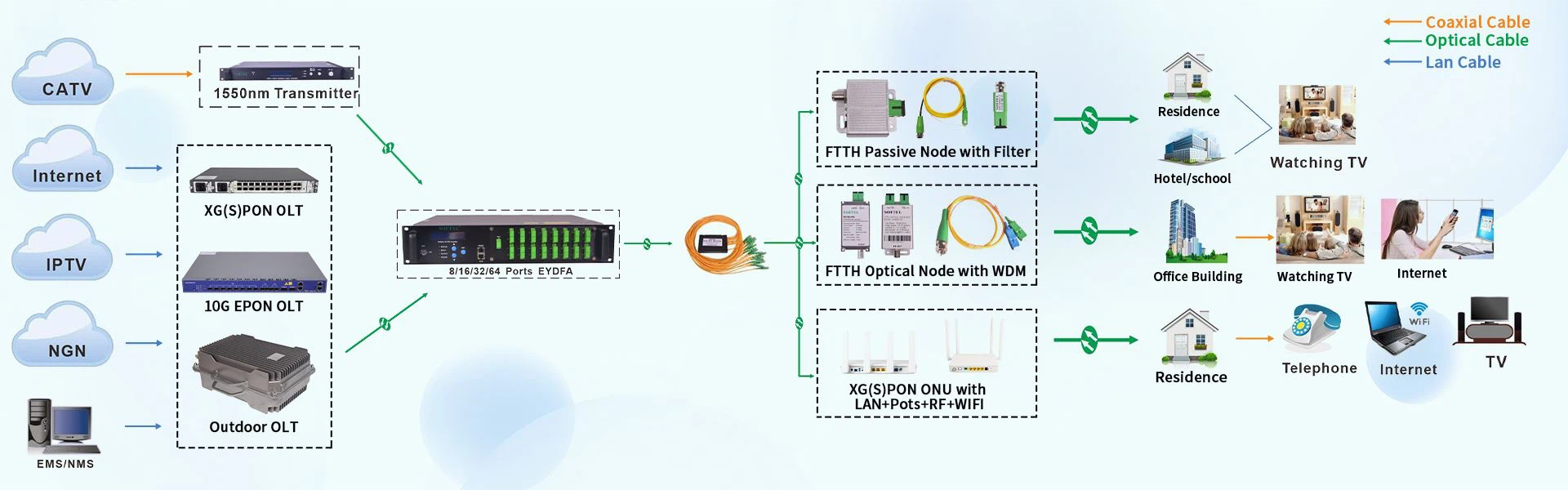
Fiber optics is a method of transmitting information over long distances using light instead of electrical signals. This technology has revolutionized network communications and made it possible for people to communicate faster and more efficiently. Here's how fiber optics works for network communications:
Fiber Optic Cables
Fiber optic cables are made up of tiny strands of glass or plastic that are thinner than a human hair. These strands are bundled together and encased in protective coatings for strength and durability. When light is passed through these strands, it reflects off the walls of the strand and bounces through the length of the cable. This process ensures that the signal remains strong and clear over long distances.
Transmission and Reception
The fiber optic cables transmit light signals that carry the data being transferred, including voice, video, and internet information. These signals are transmitted at very high speeds, so the data can be sent and received almost instantaneously. At the receiving end, the fibers are attached to a receiver that converts the light signals back into electrical signals so that the data can be processed and used by devices and computers.
Advantages of Fiber Optic Network Communications
Fiber optics has many advantages over traditional copper wires used in network communication. For one, fiber optic cables are more secure, as it's harder to intercept light signals than electrical signals. Fiber optics is also faster, can transmit higher volumes of data, and has almost no signal loss over long distances because the signal is light, not electricity.
Conclusion
Fiber optics has revolutionized network communication. It enables faster and more efficient communication, and it's more secure and reliable than traditional copper wires. As technology continues to develop, fiber optics will remain an important tool for network communications for years to come.


