

To determine whether a device is a modem, there is no need to worry about its application scenarios or forms, just look at whether it undertakes the core task of "converting a signal (such as wireless, power line, satellite signal) into a digital signal that can be recognized by the terminal, and at the same time converting backhaul back".
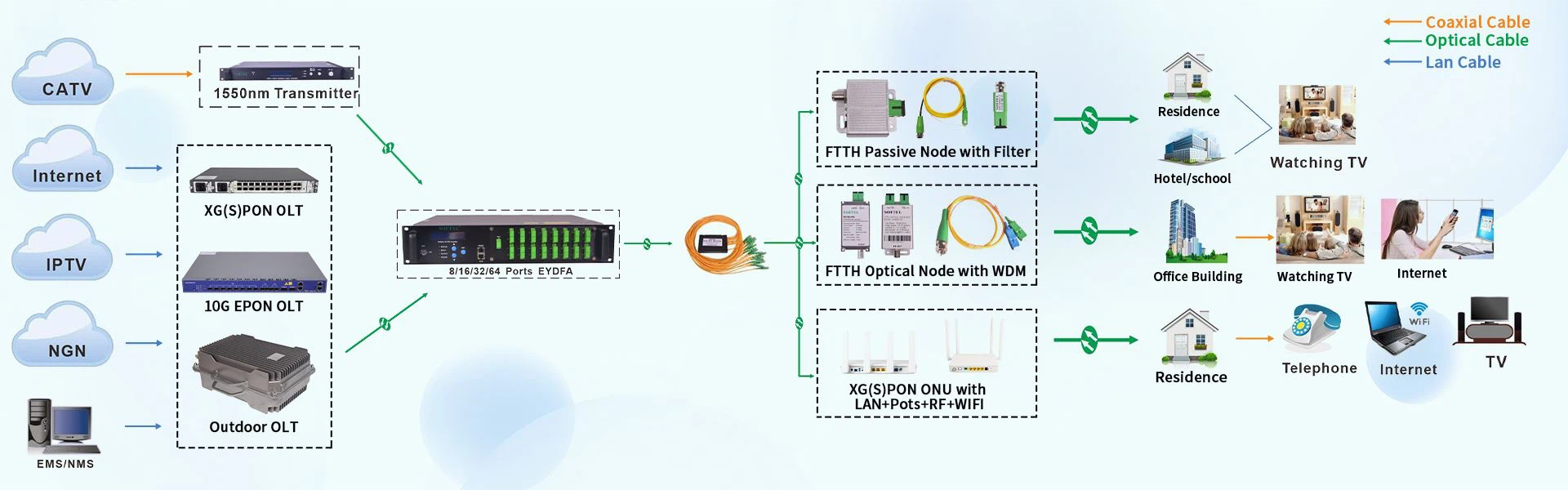
1. Fiber Modem (ONT/ONU)
The core function of adapting to optical fiber networks is the conversion of "optical signals ↔ and digital electrical signals": the optical signals transmitted by the operator's optical fibers are "demodulated" into digital electrical signals for computers and routers to use, and the digital electrical signals of the terminals are "modulated" into optical signals and transmitted back.
2. ADSL Modem
It is a modem that uses the high-frequency part of a telephone line to transmit data, commonly used in home broadband. It can realize Internet access functions without affecting phone calls, with speeds generally between 1-100Mbps, and is suitable for broadband scenarios such as old communities and rural areas where telephone lines are still used.
Adapt to the traditional telephone line network to realize the conversion of "digital signal ↔ telephone line analog signal". It is the core equipment of early broadband, such as "dial-up Internet access" and "ADSL broadband", which transmits data through telephone lines and needs to be connected to a computer or router.
3. Cable Modem
Signal transmission through cable TV coaxial cable not only has the function of modem, but also integrates routers, hubs, and bridges, and the theoretical transmission speed can reach more than 10Mbps, which is mainly used for radio and television networks and broadband users relying on cable TV lines.
It is suitable for cable TV coaxial cable networks to realize the conversion of "digital signal ↔ coaxial cable high-frequency signal". The use of cable TV cables to transmit TV signals and broadband data at the same time is common in some households, and operators need to support coaxial broadband.
4. 4G/5G Modem (with "Portable Wifi" core module)
Through the built-in 4G/5G communication module, it receives radio frequency signals (such as LTE, NR signals) from the operator's base station and "demodulates" them into digital electrical signals; At the same time, the digital signal of the terminal (computer, tablet) is "modulated" into a wireless signal return base station, which is essentially the conversion of "wireless signal ↔ digital signal".
Relying on cellular networks, 4G or 5G mobile base station signals are converted into digital signals, which are commonly used in mobile hotspots, IoT devices, etc., and can provide network connectivity in areas without fiber coverage and outdoors, with peak speeds of up to 10Gbps for 5G modems
5. LoRa/NB-IoT Modem
The core of adapting to LoRa low-power WAN technology is to "modulate" the digital signal of IoT devices into LoRa radio frequency signals (suitable for long-distance, low-rate transmission, such as 1-10km coverage), and "demodulate" IP signals at the gateway to connect to the Internet, or directly complete the conversion of "LoRa signal ↔ to digital signal" in point-to-point scenarios. It is mostly used for IoT devices such as smart meters (water meters, electricity meters) and environmental monitoring sensors that do not require high-frequency transmission.
NB-IoT Modem is adapted to NB-IoT (Narrow Band IoT) technology, which is a low-power WAN solution led by operators, and its functions are similar to LoRa Modem: the digital signal of IoT devices is "modulated" into NB-IoT narrowband wireless signal, transmitted through the operator's base station, and then "demodulated" into a digital signal, which is suitable for small data volume and low-frequency transmission, such as smart parking and asset tracking.
6. PLC Modem
Power line modem (PLC modem) uses home/industrial power lines as the transmission medium to realize the conversion of "digital signal ↔ power line high-frequency carrier signals". The digital signal is loaded onto a 220V/380V power line by modulation and restored to a digital signal by demodulation at the other end of the same power loop, enabling networking without additional wiring.
7. Satellite Modem
The digital signal of the terminal is "modulated" into radio frequency signals suitable for satellite transmission, such as Ku-band and Ka-band signals, and sent to communication satellites through satellite antennas. At the same time, the radio frequency signal forwarded by the satellite is received, and the "demodulation" is converted into a digital signal for terminal use, realizing the conversion of "digital signal ↔ satellite radio frequency signal".
It is used in ocean-going ship communications, polar scientific research equipment, and emergency rescue sites, such as when the ground network is interrupted after an earthquake, and transmits data through satellite modem.
This 2 types of devices that not refer to Modem
However, people easily misunderstood devices as they do not have the core function of "modem".
1.Wireless router /Wifi Router: It is only responsible for "network distribution" (distributing existing digital signals to multiple devices through wired/Wifi), and cannot directly connect to transmission networks such as optical fiber and telephone lines, and must be connected to an external modem to use it - not belonging to Modem.
2.Switch: It is only responsible for "expanding the network port", expanding one network port to multiple network ports for multi-device wired networking, without signal conversion or routing functions-it has nothing to do with modem.


