

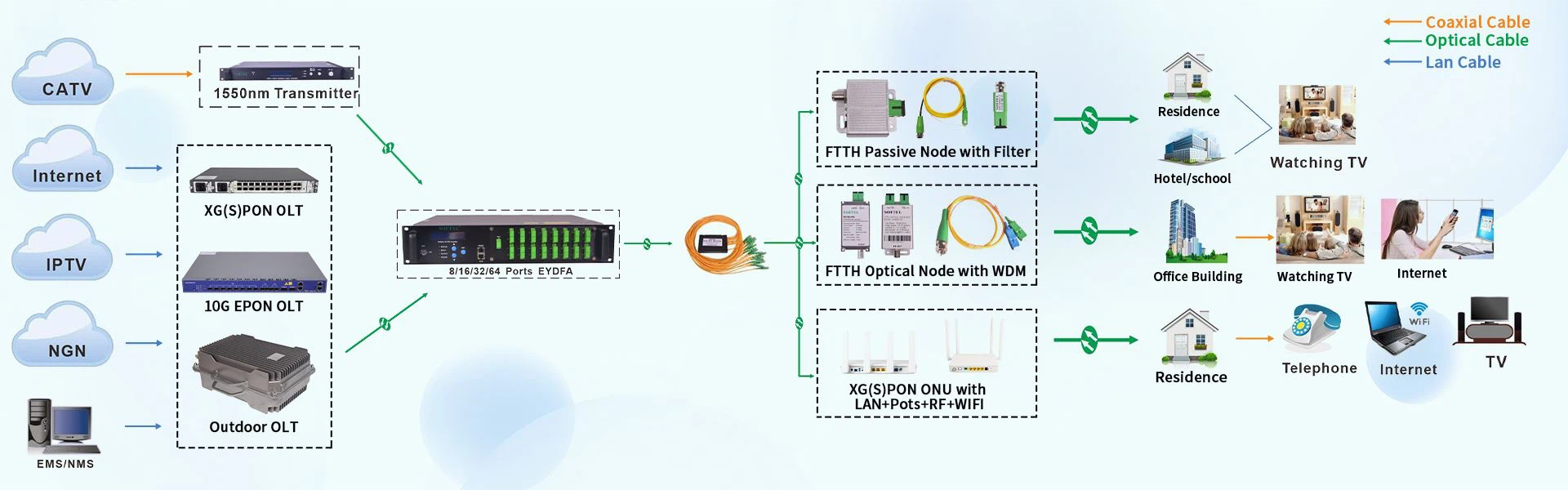
FTTH, FTTR, FTTB, and FTTO are all subdivisions of fiber optic access technology FTTx. The core difference lies in the different endpoints of the 'last mile' fiber connection, which directly determines their applicable scenarios and user experience. Simply put, FTTH goes to the home, FTTR goes to the room, FTTB goes to the building, and FTTO goes to the office.
| Connection Endpoint | Applicable Scenarios | Typical Users | ||
|---|---|---|---|---|
| FTTH | Fiber To The Home | Fiber directly to the home / residence | Ordinary households, apartments | Household users, individual residents |
| FTTR | Fiber To The Room | Fiber extends from the home / building equipment room to each room | Large apartments, villas, hotel rooms | Large-family homes, high-end hotels |
| FTTB | Fiber To The Building | Fiber to community buildings / units, then using network cables to the residence | Regular residential communities, old buildings | Community residents, mid-to-low-end residential users |
| FTTO | Fiber To The Office | Fiber directly to the enterprise office / workstation | Office buildings, enterprises, industrial parks | Enterprises, companies, office parks |
FTTH (Fiber to the Home)
It is currently the 'top-tier' solution for home access, with fiber optic cables running directly from the operator's central office to the user's home, terminating at an optical modem, and then distributing network cables or WiFi to devices in the home. The feature is that the bandwidth is completely dedicated; for example, a 1000M broadband is used solely by the user, unaffected by neighbors' internet usage, offering the best speed and stability.
Core Advantages
1. Exclusive bandwidth, no peak-time lag
2. High speed limit (supports 100M-1000M)
3. Strong stability, less affected by external interference
Solution Selection: A GPON-based FTTH solution was adopted. Splitters were deployed in the community's equipment room, with a 1×32 split ratio covering 32 households and providing 1000Mbps bandwidth per user.
Implementation Results:Measured download speeds remained stable above 980Mbps, with no buffering during peak hours (7-10 PM).Optical link loss was controlled within 17dB, supporting a transmission distance of 20km and meeting future 50G PON upgrade requirements.
Comparative Advantages: Compared to FTTB with shared bandwidth, the dedicated bandwidth of FTTH performs better when multiple devices are connected simultaneously, making it especially suitable for high-bandwidth scenarios like eSports and VR.
FTTR (Fiber to the Room)
It can be regarded as an "upgraded version" of FTTH, addressing the signal coverage issues in large spaces. For example, in villas or large apartments, a single router's WiFi may have dead zones. By connecting each room with fiber and placing a sub-router in each room, you can achieve high-speed network coverage throughout the house. The core is the combination of "fiber and WiFi6," which ensures long-distance transmission without attenuation while providing full-speed WiFi in every room.
Core Advantages
1. Whole-house WiFi with no dead spots, full speed in every room
2. Supports multiple devices simultaneously (20 devices without lag)
3. Fiber optic transmission without attenuation, long-range signal coverage
Solution Selection: FTTR solution based on OLT optical modules, carrying three networks over a single fiber.
Implementation Results:- Mobile device roaming interruption time reduced to within 30ms, 4K video conference latency <5ms.- Operation and maintenance costs reduced by 90%, annual fault handling instances dropped from 48 to 3.
Comparative Advantages: Compared with traditional cabling, the multi-functional single-fiber feature of FTTR greatly simplifies the hotel network architecture and improves management efficiency.
FTTB (Fiber to the Building)
It is a relatively common 'economy' solution, where the fiber optic cable reaches only the building's equipment room in the residential complex, and then connects to each household from the equipment room using network cables (such as Cat5e). The drawback is shared bandwidth; for example, 100 households in a building share 10G bandwidth, so internet speed may slow down during peak hours (7-10 PM). However, the construction cost is low, making it suitable for large-scale coverage.
Core Advantages
1. Low construction cost and wide coverage
2. No need for in-home wiring, easy to install
Solution Selection: FTTB LAN hybrid solution, with fiber to the building and Cat5e cables for in-building connections, retaining the original corridor switches.
Implementation Results:Single-user bandwidth increased to 200 Mbps, with a cost reduction of 40% compared to FTTH.Using existing lines reduced the amount of new wiring required, completing the transformation of the entire community within 2 weeks.
Comparative Advantages: In the renovation of older communities, FTTB is significantly more cost-effective, suitable for scenarios with limited budgets but requiring basic speed upgrades.
FTTO (Fiber To The Office)
Specifically designed for corporate scenarios, fiber optic cables are directly connected to every office or workstation of the enterprise, and even to devices like servers and printers. The advantage is that it supports high concurrency, so dozens of people can participate in video conferences or transfer large files simultaneously without lag. Additionally, the corporate IT department can more conveniently manage the network for each workstation, with higher security.
Core Advantages
1. Supports high concurrency (over a hundred people working simultaneously without lag)
2. Network security is controllable, making it convenient for enterprise IT management
3. Can directly connect to servers, monitoring devices, and other equipment
Solution Selection: Softel Small Full Optical FTTO solution, using XGS-PON technology to directly connect 256 optical APs and a converged gateway.
Implementation Results:- Communication costs reduced by 40%; VLAN isolation enables secure separation of workshop dual networks (production network / management network).- Workshop WiFi6 AP supports seamless roaming, with device network latency reduced to within 10ms, meeting industrial automation requirements.
Comparative Advantages: Compared to FTTB shared bandwidth, FTTO's dedicated optical fiber is more suitable for industrial production in terms of stability and security.
How to choose a solution for fiber optic access?
Home Scenarios:
- Small to medium-sized homes (<120㎡): Prioritize FTTH, balancing cost and performance.
- Large homes (>150㎡): FTTR is the optimal solution, especially for smart home users.
- Older communities: FTTB LAN offers high cost-effectiveness, quickly upgrading using existing wiring.
Enterprise Scenarios:
- Factories/Workshops: FTTO supports industrial-grade stability and security isolation, suitable for automated production lines.
- Commercial spaces (such as 4S stores, restaurants): FTTO's high concurrency can ensure real-time services like live streaming and payment.
Special Scenarios:
- Guesthouses/Hotels: FTTR's anti-interference and long lifespan advantages are significant, suitable for environments with dense multi-user usage.
- Education/Medical: FTTO's direct fiber connection can meet high-reliability needs such as remote teaching and image transmission.


