

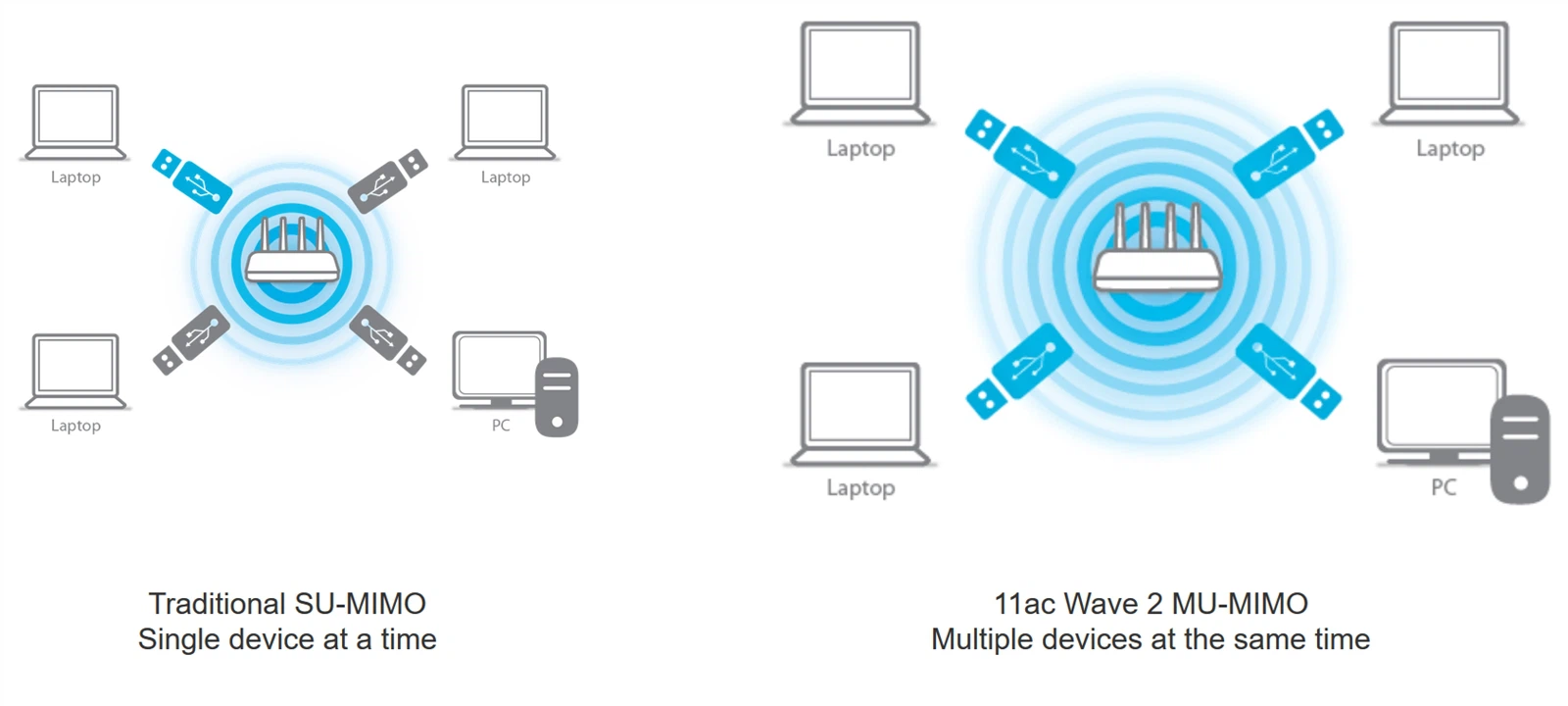
Multiple input multiple output (MIMO) is an antenna system that uses multiple antennas at both the transmitting end and the receiving end to form multiple channels between the transmitting and receiving ends in order to greatly increase the channel capacity.

Multiple-input multiple-output is a rather complicated antenna diversity technique. Multipath effects will affect signal quality, so traditional antenna systems have to use their brains on how to eliminate multipath effects. MIMO systems, on the other hand, use multipath effects to improve communication quality. In the MIMO system, the transmitting and receiving parties use multiple antennas that can work simultaneously to communicate. MIMO systems typically employ complex signal processing techniques to significantly enhance reliability, range, and throughput. Using these techniques, the transmitter sends multiple radio frequency signals simultaneously, and the receiver recovers the data from these signals. MIMO wireless communication system is one of the key technologies of future mobile and wireless communication systems. An obvious feature of the MIMO system is that it has extremely high spectrum utilization efficiency. On the basis of fully utilizing existing spectrum resources, space resources are used to obtain gains in reliability and effectiveness. End processing complexity.
key module
1. MIMO system channel model modeling
The performance of a MIMO system largely depends on the channel model. Although there are already standardized wireless propagation models and many MIMO channel models have been provided on the basis of a large number of actual measurements and theoretical research work, they have not yet been recognized by the ITU. Recognized standardized MIMO channel model (3GPP has formulated channel model standards for MIMO). Therefore, understanding and mastering the characteristics of wireless MIMO channels in indoor and outdoor environments, establishing static models and specific dynamic models of MIMO channels, is essential for selecting appropriate system structures and designing excellent signal processing algorithms to realize the potential huge channels of MIMO systems Capacity, achieving the expected performance is critical.
2. Capacity of MIMO system
Compared with the traditional single-antenna system, the MIMO system has greatly improved both in terms of performance and data transmission rate. First, Telestar and Foschini conducted an in-depth analysis of the channel capacity of the MIMO system. They respectively analyzed the Gaussian noise The research on the capacity of the MIMO system under the following conditions shows that, under the assumption that the antennas are independent of each other, the multi-antenna system is significantly improved compared with the single-antenna system. In the case of knowing the transmission characteristics of the channel, Foschini's research shows that: when M=N, the obtained channel capacity increases proportionally to N. Under the same transmission power and transmission bandwidth, the channel capacity of the system is about 40 times higher than that of the single-input single-out (SISO) system.
3. Design of MIMO antenna array
In general, base station antennas are erected high, and the near-field scattering around the antenna array is relatively weak. Therefore, in order to obtain uncorrelated signals on different array elements, it is often necessary to maintain at least 10 times the wavelength spacing between array elements. When the number of antennas is large, there may be obstacles to erecting base station line arrays. For mobile terminals, due to the abundant near-field scatterers, it is generally believed that the distance between antenna elements is more than 1/2 wavelength to make the signal correlation weak enough. The polarized antenna array can use mutually orthogonal polarization states at the same spatial position to realize the apparent irrelevance of the array elements, so that the size of the antenna array can be relatively reduced.
4. Signal processing of MIMO system
An array antenna communication system in a fading environment faces co-channel interference and inter-symbol interference. In order to approach the capacity of a multi-antenna system, good signal processing techniques are required. High-performance, low-complexity signal detection methods or joint detection methods have always been a hot topic for researchers.
5. The complexity problem of MIMO system
Since the signal in the MIMO system is extended to the two-dimensional space-time, compared with the single-antenna system, the complexity of the channel estimation, channel equalization, decoding, and detection links will increase with the number of antennas or the increase of the signal modulation order. The amount of algorithm calculation will directly affect the processing delay, device power consumption and standby time. At the same time, in practical applications, a key factor limiting MIMO systems is the high cost brought by multiple radio frequency links. To reduce the computational complexity of "software", provide simpler and more effective signal processing methods and various space-time encoding and decoding schemes for MIMO systems. For reducing the "hardware" cost, antenna selection is a very critical technology, which can greatly reduce the processing complexity and hardware cost while maintaining the advantages of MIMO technology, and is a research focus to promote the practical application of MIMO systems .
6. Diversity and multiplexing of MIMO systems
The essence of MIMO system is to provide diversity gain and multiplexing gain. The former guarantees the transmission reliability of the system, and the latter improves the transmission rate of the system. Most of the early literature focused on the use of transmit diversity and spatial multiplexing alone or in combination with coding. Studies have shown that multi-antenna systems can provide diversity and spatial multiplexing at the same time, and there is a trade-off between the two. It is worth exploring to maximize the system gain by rationally utilizing the two modes of diversity and multiplexing in MIMO systems.
7. (Multi-cell) Multi-user MIMO system
Theoretically, the capacity domain of the multi-user MIMO system has been solved, but how to make the capacity domain meet the transmission rate requirements of various users is still not well resolved. Furthermore, in the broadcast channel, due to the inter-antenna and inter-user interference in the MIMO system, how to design the transmission vector to eliminate the co-channel interference between users, how to make the system capacity and the power control of each user's specific QoS when the power is limited The problem of optimization and related technologies in the presence of multi-cell multi-user systems are still the focus of research.
Basic Principles of MIMO Technology
MIMO technology refers to the use of multiple transmitting antennas and receiving antennas at the transmitting end and receiving end, respectively, so that signals are transmitted and received through multiple antennas at the transmitting end and receiving end, thereby improving communication quality. It can make full use of space resources, realize multiple transmissions and multiple receptions through multiple antennas, and can double the system channel capacity without increasing spectrum resources and antenna transmission power, showing obvious advantages, and is regarded as the next generation of mobile The core technology of communication. The essence of MIMO technology is to provide space diversity gain and space multiplexing gain for the system.
The transmitting end maps the data signal to be sent to multiple antennas through space-time mapping, and the receiving end performs space-time decoding on the signals received by each antenna to recover the data signal sent by the transmitting end. According to different space-time mapping methods, MIMO technology can be roughly divided into two categories: space diversity and space multiplexing. Space diversity refers to the use of multiple transmitting antennas to send signals with the same information through different paths, and at the same time obtain multiple independently fading signals of the same data symbol at the receiver, so as to obtain the reliability of reception improved by diversity. For example, in a slow Rayleigh fading channel, using one transmit antenna and n receive antennas, the transmitted signal passes through n different paths. If the fading between the antennas is independent, the maximum diversity gain can be obtained as n. For transmit diversity technology, it is also to use the gain of multiple paths to improve the reliability of the system. In a system with m transmitting antennas and n receiving antennas, if the path gains between antenna pairs are independent and uniformly distributed Rayleigh fading, the maximum diversity gain that can be obtained is mn. At present, space diversity technologies commonly used in MIMO systems mainly include Space Time Block Code (Space Time Block Code, STBC) and beamforming technologies. STBC is an important coding form based on transmit diversity, the most basic of which is the Alamouti scheme designed for two antennas.
The most important part of the STBC method is to make the signal vectors to be transmitted on multiple antennas orthogonal to each other. The use of STBC technology can achieve the effect of full diversity, that is, when the STBC technology is used in a system with M transmitting antennas and N receiving antennas, the maximum diversity gain is MN. Beamforming technology is to send the same data through different transmitting antennas to form shaped beams directed to certain users, thereby effectively improving antenna gain. In order to maximize the signal strength of the beam directed to the user, the beamforming technology usually needs to calculate the phase and power of the data sent on each transmit antenna, which is also called the beamforming vector. Common beamforming vector calculation methods include maximum eigenvalue vector, MUSIC algorithm, etc. The maximum transmit diversity gain that can be obtained by using the beamforming technology for M transmit antennas is M. Spatial multiplexing technology is to divide the data to be transmitted into several data streams, and then transmit them on different antennas, thereby increasing the transmission rate of the system. The commonly used spatial multiplexing method is the vertical layered space-time code proposed by Bell Laboratories, that is, V-BLAST technology.


