

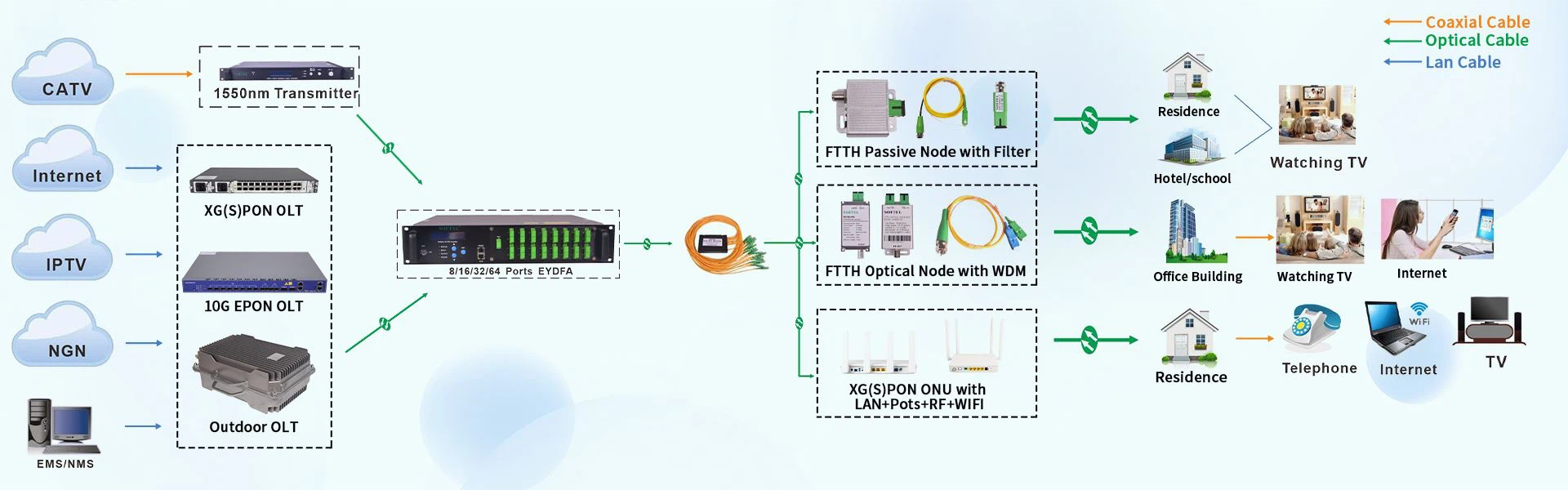
As a high-bandwidth, high-security data transmission medium, optical fiber is widely used in various large and medium-sized networks. Due to the high cost of cables and equipment, optical fibers are mostly used only for network backbones, that is, system wiring for vertical backbone subsystems and building group subsystems, to achieve connection between buildings and floors, and is also currently used for transmission Horizontal cabling subsystems with higher requirements for speed and security.
Because light travels differently in different substances, when light is emitted from one substance to another, refraction and reflection occur at the interface between the two substances. Moreover, the angle of the refracted light changes with the angle of the incident light. When the angle of the incident light reaches or exceeds a certain angle, the refracted light will disappear, and all the incident light will be reflected back. This is the total reflection of the light. Different materials have different refraction angles for the same wavelength of light (that is, different materials have different refractive indices), and the same materials have different refraction angles for different wavelengths of light. Optical fiber communication is based on the above principles.
Not all the light incident on the end face of the optical fiber can be transmitted by the optical fiber, but only the incident light within a certain range of angles. This angle is called the numerical aperture of the fiber. A larger numerical aperture of the optical fiber is advantageous for the docking of the optical fiber. Different manufacturers have different numerical apertures (AT & T ?? Corning).


