

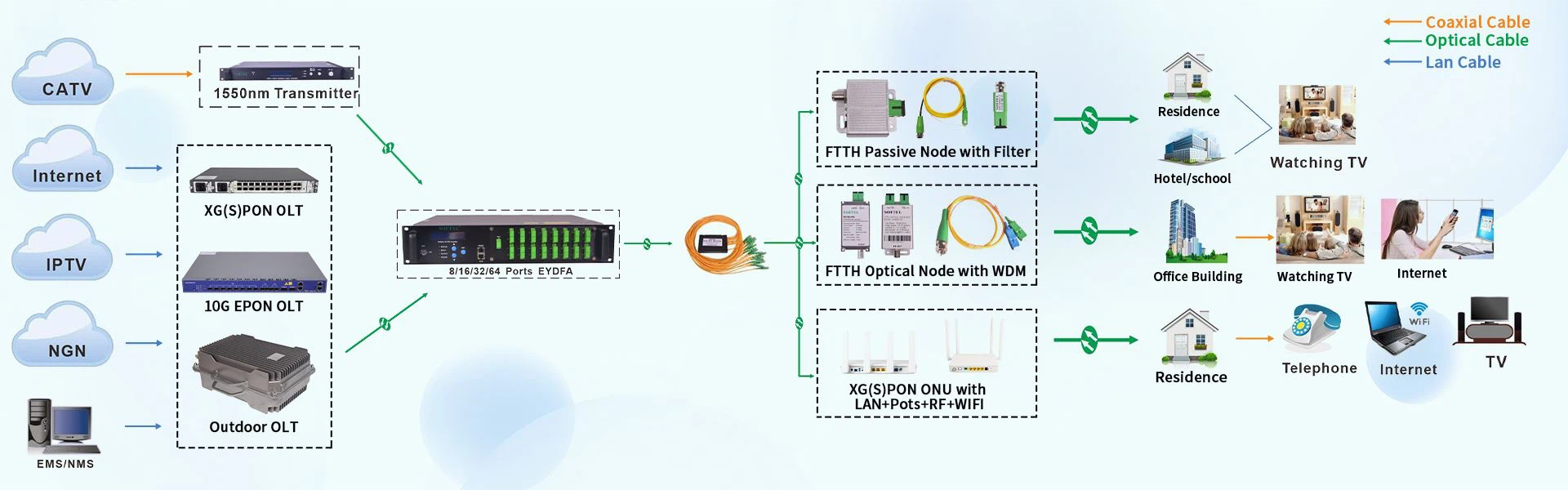
What is fiber optic connector?
Fiber optic connectors are device that make a detachable connection between optical fibers and optical fibers. The basic requirement of the optical fiber connector is to precisely connect the two end faces of the optical fiber, so that the optical energy output by the transmitting fiber can be coupled to the receiving fiber to the maximum extent, and the impact on the system due to its intervention in the optical link is minimized. Optical fiber connectors are key components in optical fiber communication systems, which are widely used in telecommunications, data centers, radio and television and other fields.
Main component of a fiber optic connector
1. Ferrule
It is usually made of ceramic or metal and is used to hold the fiber in place and ensure that the fiber core is aligned.
The shape of the end face may be planar (PC), arc (UPC), or beveled (APC).
2. Connector Housing
Protects ferrules and fibers, usually made of metal or plastic.
Housing shapes and designs vary depending on the connector type (e.g., SC, FC, LC).
3. Buckle or threaded mechanism
It is used to secure the connector and ensure a stable connection. For example, SC uses snaps, FC uses threads.
4. Boot
Protects the connection point between the fiber and the connector to prevent the fiber from bending or damage.
Types of fiber optic connector
Common optical fiber connectors are: FC, SC, ST, LC, MPO, MTRJ, MU, SMA, E2000, DIN, D4, etc.
And the main types of connectors commonly used in optical communication are FC, SC, ST, LC, and MPO.
| Connector Type | Color | Appearance | Interface Shape | Fixation | Features | Application |
|---|---|---|---|---|---|---|
| SC (Subscriber Connector) | Blue (PC/UPC) or Green (APC) | Square | Square | Snap fastening | large size and easy to plug and unplug | Datacom, Telecom Networks, Fiber-to-the-Home (FTTH) |
| FC (Ferrule Connector) | Silver or black | Rotundity | Rotundity | Thread rotation | High stability and good seismic performance | Single-mode optical fiber, test equipment, high-precision instruments |
| LC (Lucent Connector) | Blue (PC/UPC) or Green (APC) | Small Square | Square | Snap fastening | Compact and suitable for high-density cabling | Data centers, high-speed network equipment |
| ST (Stab&Twist) | Silver or black | Rotundity | Rotundity | Bayonet | Easy to plug and unplug, but slightly less stable than FC | Local Area Network (LAN), Fiber Optic Cabling |
| MPO (Multi-Fiber Push-On) | Black or gray | Rectangle | Rectangle | Plugging and unplugging | High-density connection, pluggable design | Data center, high-speed multi-channel fiber optic transmission |
| MTP (Multi-fiber Termination Push-on) | Black or gray | Rectangle | Rectangle | Plugging and unplugging | Upgraded version of MPO, with better performance and strong detachability | High-speed data center, multi-channel fiber optic network |

When you see FC/UPC, FC/APC, SC/UPC, LC/APC, etc., you will definitely wonder what UPC and APC mean?
In order to allow the end faces of the two fibers to be in better contact, the ferrule end faces of fiber optic connectors are usually ground into different structures. Different grinding methods determine the transmission quality of optical fibers, which is mainly reflected in return loss and insertion loss. Insertion loss refers to the loss of signals through connectors or cables. In general, the typical insertion loss of PC, UPC, and APC connectors should be less than 0.3dB. Compared to APC connectors, UPC/PC connectors are generally easier to achieve low insertion loss due to the smaller air gap. Insertion loss can also be caused by dust particles between connector endfaces.
There are three common types of fiber endface grinding: PC, UPC, and APC. PC/APC/UPC represents the front-face structure of the ceramic ferrule. APC connectors are usually green, and UPC/PC connectors are blue.
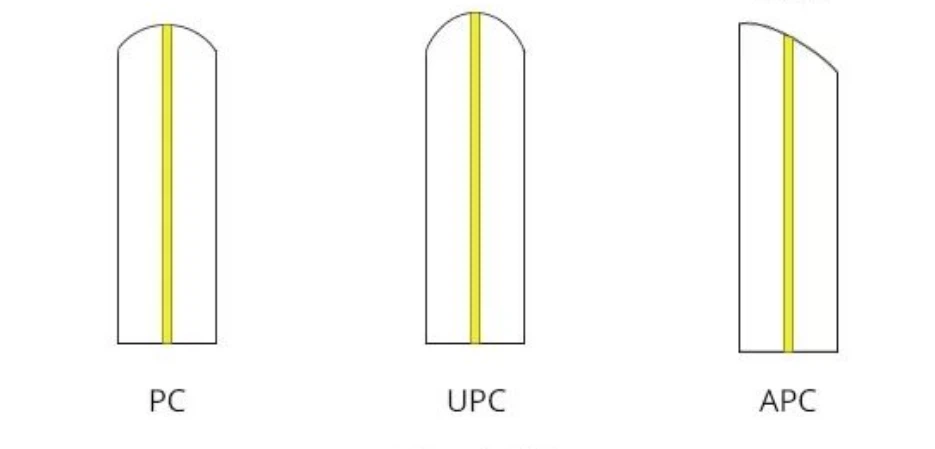
PC (Physical Contact) is a microspherical grinding and polishing, the ferrule surface is ground into a slight spherical surface, and the fiber core is located at the highest point of bending, which can effectively reduce the air gap between the fiber components and make the two fiber end faces reach physical contact. It is a general-purpose connector and is suitable for general optical fiber communication.
UPC (Ultra Physical Contact), a super-physical endface. The UPC connector end face is not completely flat and has a slight arc for a more precise mating. The UPC is based on the PC to optimize the end polishing and surface finish, and the end face looks more dome-shaped. The end face is curved, the reflection loss is lower than that of PC, and the performance is between PC and APC. It is mainly used in high-speed optical fiber networks and data centers.
APC (Angled Physical Contact) is called Angled Physical Contact, and the end face of an optical fiber is usually ground into an 8° bevel, which has lower reflection loss and better performance. The 8° angle bevel makes the fiber end face tighter and reflects light through its bevel angle to the cladding instead of returning directly to the light source, providing better connection performance. It is mainly used for high-performance optical fiber networks, CATV, and long-distance transmission.


