

What are the advantages of EPON
EPON is a relatively new type of PON technology. It is proposed by IEEE802.3EFM (Ethernet for the First Mile). It is a broadband access technology that combines Ethernet and PON. It adopts a point-to-multipoint network structure and passive optical fiber transmission. Mode, based on high-speed Ethernet platform and TDM time division MAC media access control mode from electrical characteristics. The four major functions of mechanical characteristics, regulatory characteristics, and functional characteristics basically adopt the Ethernet standard. At the data link layer, a new control protocol based on the TDM idea is adopted. Simply put, the combination of Ethernet and PON creates an Ethernet passive optical network. EPON uses a single optical fiber to connect to the OLT, and then the OLT is connected to the ONU.
A. Saving
It saves a lot of fiber and transceivers, and the cost is lower than traditional fiber access solutions.
B. Reliable
The signal does not pass through active electronic devices in the PON transmission process, which can reduce potential points of failure; the use of passive devices can simplify the network hierarchy, and the flat network structure is easier to maintain and manage.
C. Long distance
The transmission distance of PIN is 10-20km, which completely overcomes the limitations of distance and bandwidth of Ethernet and xDSL access methods, and can greatly increase the flexibility of user access schemes.
D. High bandwidth
Compared with xDSL, PON has a higher bandwidth and can meet users' demands for bandwidth for a long time.
E. Flexible
The PON networking model is not restricted, and it can flexibly build a tree-shaped and star-shaped topology network; it is especially suitable for occasions where user access information points are scattered, and a main optical fiber can be used to meet all user access information points.
F. Multipurpose
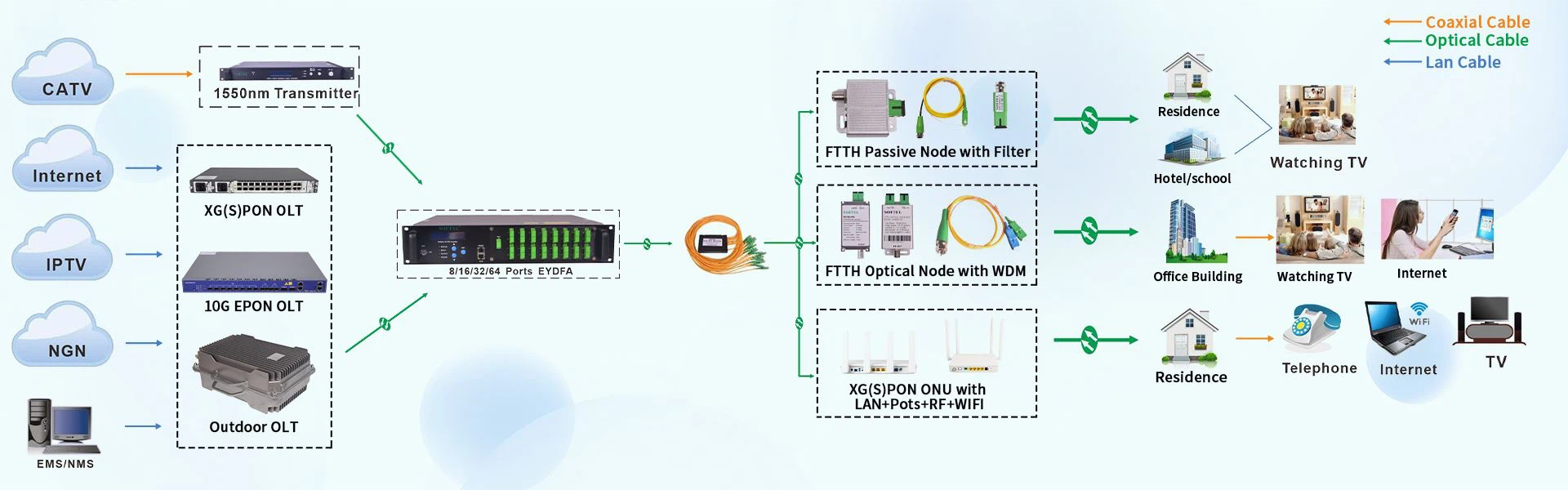
PON is a natural broadcasting network. It adopts single fiber wavelength division multiplexing technology, which can superimpose the cable TV signal into the PON network for transmission at the OLT end, and finally separate it at the user end through a splitter, which can transmit data or cable TV signal.


