

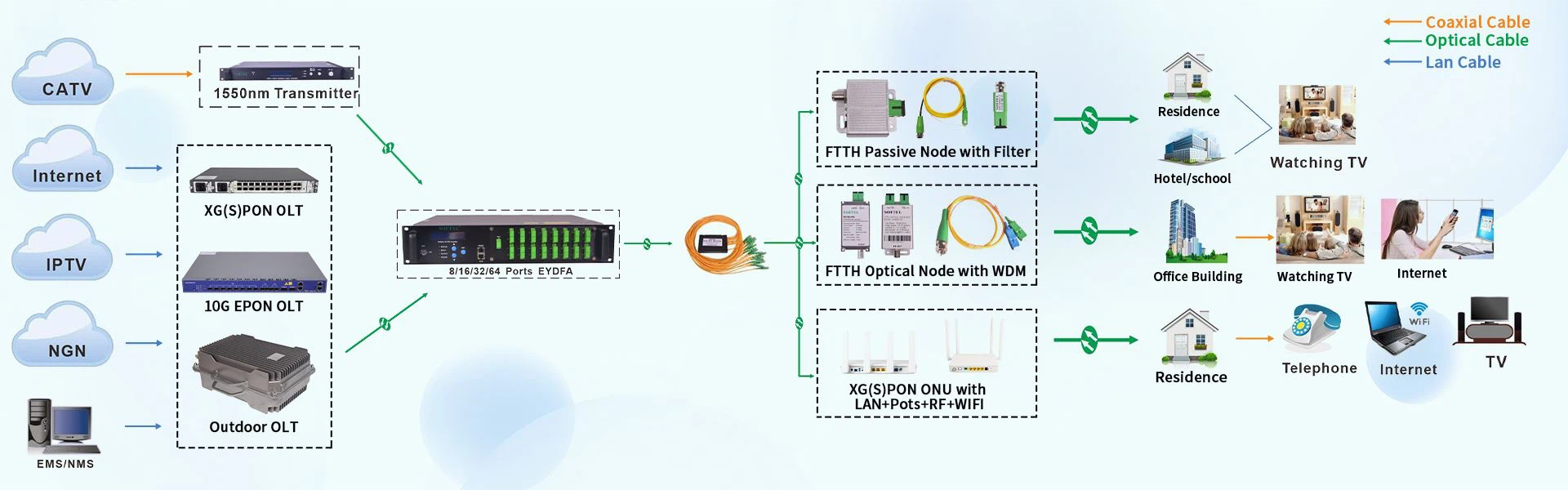
Recently, ZTE and Hangzhou Telecom completed the pilot application of the XGS-PON network at a well-known live broadcast base in Hangzhou, demonstrating their respective potentials. In this project, XGS-PON OLT+FTTR all-optical networking+XGS-PON Wi-Fi 6 AX3000 gateway and wireless router provide ultra-gigabit uplink enterprise broadband access for multiple professional cameras and 4K Full NDI (network device interface) Into the live broadcast system to realize 4K multi-view and VR high-quality live broadcast demonstrations in each live broadcast room of the base.

Nowadays, the traditional single-view "selling" live broadcast has caused aesthetic fatigue and reduced the effect of traditional live broadcast. Audiences demand all-round, immersive, multi-scenario, WYSIWYG live broadcast. Based on XGS-PON, this pilot project carried out broadcasting-level 4K full NDI and 1+N multi-view live broadcast, and realized the live delivery demonstration and VR live broadcast experience of Tianyi cloud computer. Compared with the current 1080P RMTP (Real Time Messaging Protocol) deep compression, 4K Full NDI technology has the advantages of shallow compression, high fidelity, 4K high image quality, and millisecond-level low latency. This technology is suitable for scenarios that require high remote real-time interaction and synchronization, such as live reports, live connections, and online competitions. However, this technology has extremely high bandwidth requirements. A single stream needs to reach 40M-150Mbps, and the total bandwidth of 3-way multi-view angles needs to reach 100M-500Mbps. ZTE and Hangzhou Telecom have already used the XGS-PON network, which is superior to the traditional XG-PON network. The on-site trial broadcast shows that the live broadcast images carried by the XGS-PON network are clear and smooth, reflecting its capabilities and advantages in uplink bandwidth.

The XGS-PON uplink large bandwidth feature matches the business features of the live broadcast base. The uplink bandwidth of each live room is increased from the traditional 20M-30M to 100M-500M. This solution solves the problem of bandwidth congestion caused by concurrent live broadcast or live broadcast freeze on the PON port and quality degradation caused by mixed access of other user traffic. In addition, the advantages of XGS-PON's optical splitting ratio will improve the cost performance of the network, reduce the total cost of ownership, and better meet the development needs of enterprise users. The XGS-PON network and ZTE's technology provide superior communication capabilities, enhance the live broadcast industry, and provide viewers with a superior experience.


